14 March 2026, 5 pm: Talk A Tiara of 4,000 Diamonds by João Júlio Rumsey Teixeira, followed by a conversation with Pedro Barateiro.
In September 2025, I inaugurated the exhibition Folklore at Appleton Square with a group of drawing works installed in a particular way, evoking scenes from constructed narratives in which figures and elements in tension can be recognized. The drawings presented were produced over a period of two years. These drawings were not only the largest I have ever made, but also the ones that took me the longest to complete. It was important to take as much time as necessary with each one, without haste or urgency, while the world was plunging into wars and conflicts, messages of hate and calls for peace.
Representing the duration of a gesture as if it could be eternalized on paper—while still allowing movement, action, and a process of transformation to be seen—were the principles that guided my work. The time spent on each drawing was a challenge to the accelerationism of the world, to the abyss it faces, where instant and unconsidered decisions and responses are demanded. I knew it was a risk. Taking time to make something seems increasingly difficult, almost like a provocation to the world.
The time devoted to making the drawings allowed me to reflect on actions of the past and the present. I evoked images from the past, references that shape me. For the title of the exhibition, I decided to use the term folklore, because the word—derived from folk, meaning “people,” and lore, meaning “knowledge,” “wisdom,” or “tradition”—refers to the set of traditions, customs, beliefs, artistic expressions, and popular knowledge that characterize a people’s culture. I sought to understand what remains of the identity narratives built in times of war, when the confrontation between the real and the imagined becomes blurred.
The term folklore was coined in 1846 by the British writer and researcher William John Thoms, with the aim of designating the systematic study of popular traditions. Etymologically, folklore means “the knowledge of the people” and includes elements such as legends, myths, tales, music, dances, traditional festivals, proverbs, superstitions, crafts, and everyday practices. This knowledge is transmitted mainly orally or through practice across generations, playing a fundamental role in preserving the cultural identity and collective memory of a community.
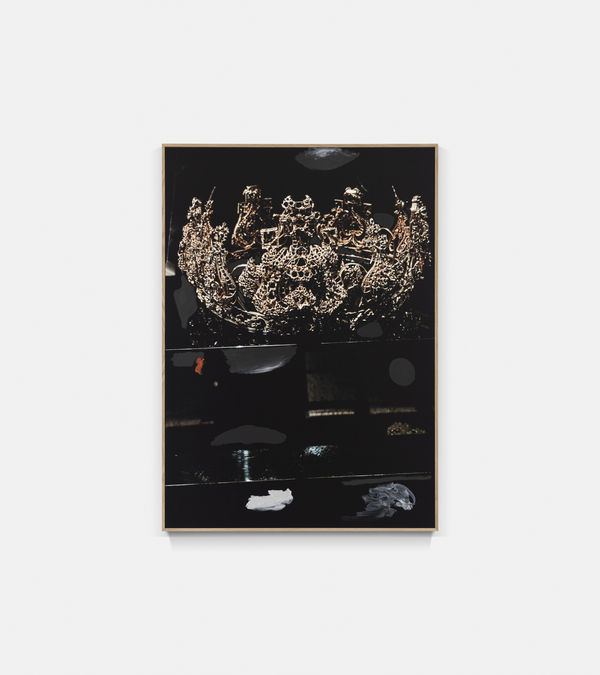
In 2023, I visited the Royal Treasury Museum at the Ajuda Palace in Lisbon for the first time. The object that struck me most during the visit was Queen Dona Estefânia’s tiara, one of the most emblematic jewels of the Portuguese Crown Treasury, associated with the queen’s brief but significant presence in Portugal. Dona Estefânia of Hohenzollern-Sigmaringen married King Pedro V in 1858, the eldest son of Queen Dona Maria II. On the occasion of the marriage, she received several jewels, including the tiara—made in the mid-19th century, composed essentially of diamonds set in gold and silver, following the Romantic taste of the period, with an elegant and balanced composition designed for official ceremonies. Although Dona Estefânia was queen for only about one year—she died in 1859 at the age of 22—the jewel became forever associated with her name.
In its original version, the tiara contained around 4,000 diamonds, which made up a significant part of the Portuguese Crown jewels. It is speculated that some of the diamonds composing the tiara—mainly from India and Brazil—belonged to Dona Maria II, the eldest daughter of King Pedro IV (Emperor Pedro I of Brazil). These gemstones were reused in other jewels commissioned by subsequent queens. Later, with the end of the monarchy, the diamonds that had been deposited at the Bank of Portugal as collateral for loans taken out by various queens remained there until they were sold, in the early 20th century, to repay those loans, and were later auctioned during the First Republic.
Through a process of historical recovery, the gilded silver components that had been preserved made it possible to reconstruct the tiara in a form similar to its original one, which had been altered over the centuries. The gilded silver metal structure that once supported the diamonds was the object on which I focused during my museum visit, due to the symbolism inscribed in it. In the tiara, we can see a skeleton—almost a filigree or a fossil—like an archaeological find, stripped of its original symbolic charge and its status as a symbol of power; an object that resembles a group of people, or a gathering. The tiara, almost a crown, represents a union through its circular and totalizing form.
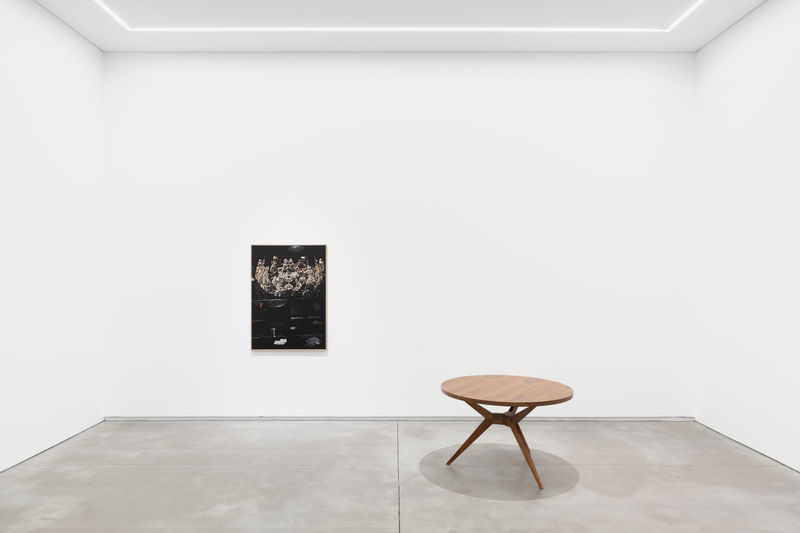
A few months later, perhaps due to a formal resemblance, I began thinking of the tiara in relation to another round, brownish object with diagonal elements. This object also evoked for me a group of people forming a circle, as if in conversation. It is the BNU table, an icon of Portuguese furniture design, designed by Daciano da Costa and reissued by Atelier Daciano da Costa. The table was conceived for the homes of employees of the Banco Nacional Ultramarino in the former Portuguese colonies.
In the early 1960s, Daciano da Costa (1) designed a system of wooden furniture for the homes of Banco Nacional Ultramarino employees in locations with limited resources—both in mainland Portugal and in the former Portuguese colonies. The central aim was to create functional, simple, and adaptable pieces, focusing on the possibility of construction using locally available materials (such as solid local wood and artisanal materials), avoiding dependence on more sophisticated industrialized materials. This project reflected not only an aesthetic concern but also a pragmatic and social approach: valuing local materials and techniques, supporting artisanal production, and responding to the real housing needs of employees in contexts of economic and technological isolation.
Banco Nacional Ultramarino (BNU) was founded in 1864, in a context of the consolidation of the Portuguese colonial empire and the need to financially structure overseas territories. Created as an issuing and commercial bank, BNU’s main mission was to support colonial administration, finance trade, public works, and the establishment of Portuguese state services in the African and Asian colonies. The bank was simultaneously an economic and political instrument, reflecting the strategy of occupation and modernization of territories under Portuguese administration.
In my search for forms that reveal historical aspects of how narratives are constructed, the tiara and the table are witnesses to another time that still informs our own, through their presence and fetishization. Folklore (Part 2) is an exhibition that seeks to reveal part of a process of thought and action by forging a relationship between objects created in distinct periods, attempting to blur the hierarchy present in each of them. The tiara of Queen Dona Estefânia and the BNU table, although distant in time and function, illustrate how power materializes through objects and the symbolism that runs through them—often unnoticed.
The tiara, a 19th-century royal jewel, asserts symbolic authority and the public visibility of the monarchy; the BNU table translates a modern, functional power that organizes daily life and discreetly extends institutional presence. In both cases, the object acts as a mediator between the individual and the institution, revealing the relationship between center and periphery and different modes of exercising influence. This comparison shows that power does not reside solely in ostentation or luxury, but also in the way everyday life is structured and disciplined through carefully designed objects.
The third work in the exhibition seeks to establish a relationship between the previous two—the table and the tiara—through the presentation of a set of 39 book covers by the publisher Duvida Press, displayed in poster format. The Duvida Press covers feature book titles by various authors, spanning fiction and theory. These book covers point to one of the issues that has most occupied me: the question of authorship.
Authorship is one of the central issues of modernism, widely debated throughout the 20th century, and is closely linked to questions of ownership and individual creation. The author was seen as the central subject of the creative process, someone who, through originality, produced an intellectual work worthy of legal protection and moral recognition. Copyright legislation consolidated this view by associating authorship with an identifiable human person, responsible for both the content and the symbolic and economic value of the work.
In the 21st century, especially with the advancement of digital technologies and artificial intelligence, this conception has shifted. Creation is no longer exclusively individual and increasingly involves collaborative, algorithmic, and automated processes. AI, capable of generating texts, images, and music, challenges the traditional notion of authorship, since it is not a human subject but acts as an active tool in the creative process. This raises questions about who the author is: the programmer, the user, the company that owns the technology, or none of them.
As a result, the idea of intellectual property becomes more fluid and complex. If in the 20th century authorship was anchored in human originality, in the 21st century it is negotiated between humans, machines, and systems. Contemporary debate not only revisits the legal foundations of authorship but also questions its ethical, cultural, and social limits in a scenario increasingly mediated by artificial intelligence.
We are currently witnessing an accelerated transformation of production and cognition processes. We live amid a constant reconfiguration of labor, now far more mechanized, confronting authorial work with its own condition. The role of the author is linked to the figure of the editor. The choice of a particular raw material, image, or object actually corresponds to a set of circumstances that go beyond geometry, form, or color. In the context of the growing presence of artificial intelligence in our lives, it becomes crucial to question the use, provenance, and fabrication of images and objects, and how they affect our perception of reality. It is also important to question ethics in the production of images and objects alike.
In the speed and fluidity of the system in which we live, attention and time are increasingly precious. Works of art attempt to function as time capsules, where immortality exists in a present form. Post-capitalist production, which has contaminated all image and object production in post-truth society, used the “artistic gesture” of authorship as intellectual property to assign value to works. But has the time come when this gesture has perhaps become unnecessary? Can production continue without human intervention? Is it still necessary? Like the brand of jeans, a car, or a sofa. We live in another time, collapsing in on itself, propelling us toward ourselves—full of individual desires, but lacking collective purpose.
The exhibition is presented with the collaboration of Atelier Daciano da Costa and Galeria Filomena Soares.
Acknowledgements: Jaime Welsh, Inês Cottinelli.
(1) Daciano da Daciano (1930-2005) was a pioneer of industrial design in Portugal, as well as an interior designer and teacher. Over more than five decades, he designed interiors and furniture for iconic public and cultural buildings such as the Biblioteca Nacional, the Calouste Gulbenkian Foundation, the Casino do Estoril, the Belém Cultural Centre and the Casa da Música in Porto.


-
 Pedro BarateiroFolklore, 2026Gouache and inkjet print on photographic paper in a wood frame122 x 86,8 cm (framed)
 -
Daciano da CostaBNU TABLE, 1963Australian Wood structureD. 114 x A. 72 cm
-
Pedro BarateiroDuvida Press, 2010–ongoing39 Inkjet print on photographic paper59,4 x 42 cm (each), variable dimensionsEdition of 3 plus 1 artist's proof